Table of Contents
- Navigating Colombian Visa Requirements with a Criminal Record
- Can a Felon Get a Visa in Colombia?
- FBI Background Check Requirements for U.S. Applicants
- Apostilles and Official Translations: Ensuring Application Success
- Criminal Offenses That Increase the Risk of Visa Denial
- Seeking Help: Immigration Specialists and ColombiaLiving.vet’s Role
- Planning Your Colombian Visa Journey
Navigating Colombian Visa Requirements with a Criminal Record
Whether a felon can get a visa in Colombia depends on the nature of the offense, but a criminal record does not automatically disqualify an applicant.
In order to apply for a visa all applicants will need to undergo a Criminal Background Check. American citizens must provide an FBI Identity History Summary rather than a state-level report. This document needs to be translated into Spanish by a translator accredited by the Ministry of Foreign Affairs of Colombia. Additionally, both the background check and the apostille must be no older than six months when you submit your application.
Certain serious offenses trigger permanent inadmissibility. Migración Colombia works with U.S. ICE through the Angel Watch program to intercept sex offenders, especially those with crimes against minors. Once denied entry under Decree 1727 of 2020, an individual is permanently barred from Colombia. But does that mean a felon can get a visa? The answer depends on the circumstances.
Key Takeaways
- A felony conviction does not automatically bar you from obtaining a visa in Colombia, but certain serious offenses, particularly sex crimes, can trigger inadmissibility under Colombian law.
- Having a criminal history does not necessarily prevent U.S.
- To start off, there really isn't any automatic disqualification due to having a criminal history but some types will make things much harder than others.
- Having past convictions does not automatically exclude an applicant from a Colombian visa application but will increase the attention placed on their case.
- If there's any confusion about felons getting a visa to Colombia, the answer is that they definitely can, but with the proper help making plans aren't as daunting as some think.
Can a Felon Get a Visa in Colombia?
A felony conviction does not automatically bar you from obtaining a visa in Colombia, but certain serious offenses, particularly sex crimes, can trigger inadmissibility under Colombian law. The final decision rests with Migración Colombia, and every application is reviewed case by case.
All visa applicants must submit a certified criminal background check. For U.S. citizens, that means the FBI Identity History Summary Check; state or local police records are not accepted. The document must be authenticated with a federal apostille from the U.S. Department of State, and any part not in Spanish requires a translation by an official translator registered with Colombia’s Ministry of Foreign Affairs. Both the background check and the apostille must be issued less than six months before submission, although some filing timelines shorten that window to 90 days. These requirements are set by Colombian Resolution 5477, and failing any one of them will lead to rejection.
Even after you’ve prepared your paperwork, immigration authorities can deny entry under Decree 1727 of 2020. During the first quarter of 2025, Migración Colombia blocked 1,014 foreign nationals, including 16 U.S. citizens identified through the Angel Watch program, a collaboration with U.S. Immigration and Customs Enforcement that flags registered sex offenders. Through Angel Watch, U.S. ICE shares near-real-time data on offenders trying to travel to Colombia. Individuals convicted of sex crimes against minors can be permanently prohibited from entering the country.
Because every case hinges on the specifics of your record, I strongly recommend speaking with a Colombian immigration attorney. We can connect you with experienced professionals, but we’re not lawyers and do not offer legal advice.
For U.S. applicants, the process begins by securing the FBI Identity History Summary Check. We’ll walk through how to order one, have it apostilled, and get it translated, without unnecessary stress. At ColombiaLiving.vet, we’re your landing pad in the Colombian mountains, and we’re here to help veterans handle these steps so you can focus on building your new life in the Andes.
FBI Background Check Requirements for U.S. Applicants
Having a criminal history does not necessarily prevent U.S. applicants from getting visas to enter Colombia, although there are strict procedures regarding the type of background investigation needed. The Colombian government requires that all visa applications from the United States include an FBI Identity History Summary Check rather than any state-level or local police report. No other documents from local or state law enforcement agencies will be accepted as proof of a clean record in place of an FBI check.
The information provided in the FAQ of ColombiaLiving.vet states that under Resolution No. 5477 of Colombia, a federal background check is mandated for all visa applicants, regardless of nationality. According to this resolution, the acceptable certificate for U.S. citizens is the FBI Identity History Summary Check; local police clearance certificates or state records will not be accepted by Colombian immigration officials. Even though you may have committed crimes before, a background check is just part of procedure rather than a rejection.
The FBI record is valid for only six months from its date of issue. If this requirement isn't met, the Colombian immigration authority will decline your application. So make sure to order the report, obtain the apostille, and have the official translation ready within that short timeframe.
A federal apostille from the U.S. Department of State must authenticate the FBI report; a simple notary seal or state-level certification will not satisfy Colombian requirements. Once apostilled, the document must be translated into Spanish by a traductor oficial registered with the Colombian Ministry of Foreign Affairs. Substitute translations or self-translated pages are routinely rejected, making this the most frequent cause of visa application delays and denials.
There's also a four-step process involved in going from ordering the FBI background investigation to producing the final product. It goes as follows:
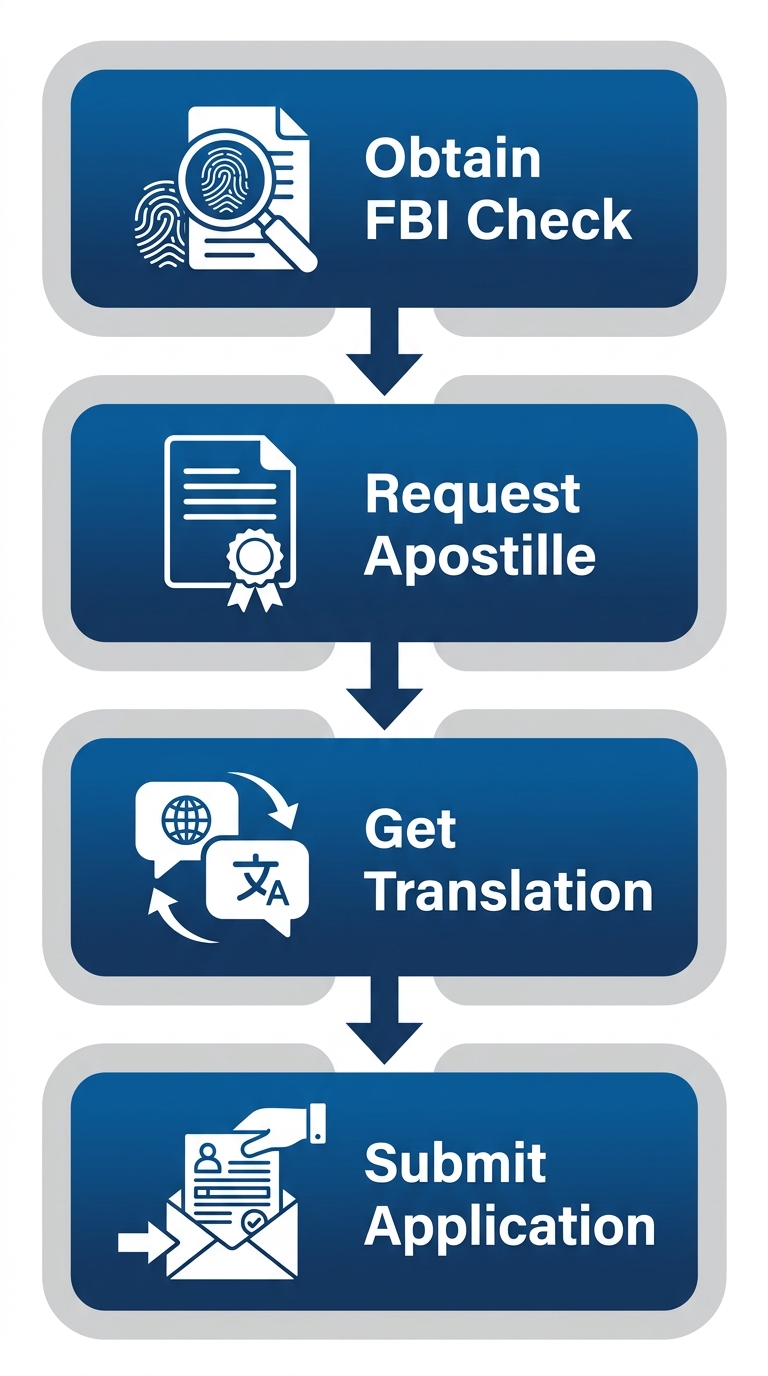
Common rejections stem from missing or incorrect apostilles and translations, so attention to detail here is critical. Once you have your FBI check in hand, getting it apostilled and translated by an approved translator will complete the document package and prepare it for submission. Verifying each step avoids the number-one reason applications are returned.
Apostilles and Official Translations: Ensuring Application Success
I've worked for years with veterans moving back here from other countries, and there was always an application that would just get hung up if their FBI Identity History Summary Check was signed off with just a notary seal. Colombia is part of the Hague Apostille Convention, which means you can't rely on any notarizations done in your home country - a federal apostille from the U.S. Department of State (the “stamp” on top of the FBI report confirming who signed what) needs to appear. No matter how official a local notary looks, his seal won’t do. The visa guide states that failing to include the federal apostille or using state-level notary services is a common reason veterans are rejected.
Once the apostille has been obtained, the final hurdle is a mandatory Spanish translation by a traductor oficial, an officially registered translator in accordance with the Colombian Ministry of Foreign Affairs. Colombian immigration does not accept unofficial translated criminal records certificates; only an authorised traductor oficial will be accepted. It is also important to bear in mind that although a validly apostilled document will still be rejected should there not be an authorised traductor oficial involved when doing the translation.
There’s timing involved here as well; start early and put all of your deadlines in a calendar to avoid surprises. The background check is only valid for six months from its issue date, so you must obtain the apostille, secure the certified translation, and submit the complete visa application within that window. So if you get your background check back from the company before you leave home but don’t do anything else with it until after arriving in Colombia, then you’ve missed out! Submitting an improperly apostilled document or an uncertified translation is the single most common reason Colombian visa applications are rejected; handling both authentication steps early removes a major avoidable pitfall. Sometimes, even if everything looks perfect, additional attention is paid to certain crimes committed on your part. If you stay up front about taking care of those things first though, then you’re free to focus on what really matters: getting settled into Cocorná.
Criminal Offenses That Increase the Risk of Visa Denial
To start off, there really isn't any automatic disqualification due to having a criminal history but some types will make things much harder than others. It all starts when you have to give a criminal history check as part of your application, per Colombian immigration law resolution No. 5477. That’s why knowing what types of crimes would be a major problem for immigration is critical to not waste your time and money on unnecessary applications.
Sex offenses committed against minors are in a category of their own. The Angel Watch program, a cooperative effort between Migración Colombia and U.S. Immigration and Customs Enforcement (ICE), enables Colombian authorities to identify and intercept registered sex offenders before they even reach the border. Under this program and the authority of Decree 1727 of 2020, anyone flagged for a sex crime involving a child can be permanently barred from entering Colombia. The consequences are not temporary: Migración Colombia reported that during the first quarter of 2025 alone, 16 U.S. citizens were inadmitted under Angel Watch, resulting in a lifetime prohibition on future travel to the country. Officers cross-reference police and judicial databases and use targeted interviews to spot inconsistencies in travel plans. If a conviction involves a minor, the risk of denial is extremely high—and typically final.
However, other criminal convictions don't necessarily preclude immigration to Colombia, although there's going to have to be an appropriate amount of documentation. All U.S.-based applicants are required to obtain an FBI Identity History Summary Check instead of a police report issued locally in their home city or state. The documents must include such proof, as well as a federal apostille supplied via the U.S. Department of State, before being professionally translated to Spanish by a translator that has been duly appointed by the Ministry of Foreign Affairs of Colombia. All three—background check, apostille, and translation—must be less than six months old at the time of visa submission. Even though newer documents could technically satisfy these requirements, they would still be double-checked again during the scrutiny phase using modern vetting technology.
For anyone with a criminal history, these realities make thorough preparation non-negotiable. A felony record does not close the door, but it raises the bar significantly—especially if the offense involves a minor. Meeting every documentary requirement and being transparent about your past is the best way to avoid a denial. For those with a criminal history, understanding these risks underscores the importance of expert assistance in navigating the process.
Seeking Help: Immigration Specialists and ColombiaLiving.vet’s Role
Having past convictions does not automatically exclude an applicant from a Colombian visa application but will increase the attention placed on their case. Many applicants in this situation find that working with someone who knows the process makes all the difference.
Immigration specialists who understand Colombian regulations save time and reduce the chance of a paperwork mistake leading to denial. For U.S. veterans, finding help that speaks both the VA income landscape and the Resolution 5477 requirements is particularly useful. Look for professionals who stress compliance — not shortcuts — and who will be upfront about the risks while guiding you through the precise documentation steps. A specialist can help you interpret your own FBI background check, spot potential red flags, and plan the strongest possible application without overselling the outcome.
Our site does not offer legal advice or promise any particular outcome. Instead, we connect residents and applicants with expatgroup.co, a trusted partner that provides hands-on visa and relocation support. Their team can walk you through collecting the correct FBI background check, obtaining the federal apostille from the U.S. Department of State, and arranging an official translation with an approved translator. This coordination is part of our broader commitment to helping veterans navigate the practical hurdles of moving to Colombia. As our own FAQ page on criminal records and Colombian visas makes clear, a criminal record does not automatically disqualify an applicant — but meeting the documentation standards is non-negotiable. We help veterans understand those standards and line up the right help to meet them.
To get it right, you’ll need:
- The FBI Identity History Summary Check, not local or state-level police records.
- An official translation of any non-Spanish documents by a translator registered with the Colombian Ministry of Foreign Affairs.
- Background checks and apostilles that are less than six months old at the time of submission.
With your team in place and your documentation squared away, then it's onward and upwards into the next stages of our visa journey with confidence. We now need to take care of some more practical points: what is involved in filling out. When will all this be done? When shall we submit all that we've completed up until that point etc. That kind of stuff.
FAQ
Is a criminal record an automatic disqualification for a Colombian visa?
No, a criminal record does not automatically disqualify an applicant for a Colombian visa. All visa applicants must submit a criminal background check, but the decision is case-by-case. Certain serious offenses, particularly sex crimes against minors, can lead to permanent inadmissibility under Decree 1727 of 2020 and the Angel Watch program.
How does the Colombian government evaluate criminal history during the visa application process?
The Colombian government requires all applicants to submit a certified criminal background check. For U.S. citizens, that means an FBI Identity History Summary. The document must be apostilled by the U.S. Department of State and translated by an official translator. Authorities then assess each application individually, using additional checks for high-risk offenders.
Do I need to submit an FBI background check when applying for a Colombian pensioner visa?
Yes, U.S. applicants for a Colombian pensioner visa must submit an FBI Identity History Summary Check rather than state or local records. The document requires a federal apostille from the U.S. Department of State and a Spanish translation by a translator registered with the Ministry of Foreign Affairs.
What types of criminal convictions are most likely to lead to a visa denial in Colombia?
Sex offenses against minors are the criminal convictions most likely to lead to a visa denial. Migración Colombia uses the Angel Watch program with U.S. ICE to identify such offenders, who can be permanently barred from entry under Decree 1727 of 2020. Other offenses are assessed individually and do not automatically prevent entry.
Planning Your Colombian Visa Journey
If there's any confusion about felons getting a visa to Colombia, the answer is that they definitely can, but with the proper help making plans aren't as daunting as some think. If you have a prior crime on file then it doesn't mean you won't be able to enter this country. Colombian Resolution 5477 simply requires proper documentation.
Here's what you'll need:
- U.S. applicants must submit an FBI Identity History Summary Check, not a state-level police record.
- All documents need a federal apostille from the U.S. Department of State; notarization won't be accepted.
- Any non-Spanish document requires an official translation by a translator registered with Colombia's Ministry of Foreign Affairs.
- Background checks and apostilles must be dated within six months, though some filings require documents no older than 90 days.
We can help you gather the right paperwork and coordinate with our partner expatgroup.co for visa assistance. Remember, we aren't a medical facility and individual results vary—please consult an immigration attorney for legal advice. Financial and benefits information is for guidance only.
Start Your Visa Journey Today
You now know that a felony conviction in the U.S. does not automatically block a Colombian visa, but the application process demands careful compliance with Resolution 5477. Your FBI Identity History Summary Check must be recent, apostilled, and officially translated to meet the strict six-month validity rule. With these requirements clear, the next step is to begin gathering your documents and seeking expert guidance. Coordinating with immigration specialists who understand the nuances of Colombian law can make a critical difference for applicants with a criminal history. For U.S. veterans, we connect you with trusted partners who can help you navigate the entire visa process. The comprehensive Money and Visa Guide explains how to meet financial requirements and secure your pensioner visa. Start by preparing your application and gathering the financial documentation required for a pensioner visa.
Resources
Related services
Veteran Expat Life Overseas
Read more → GuideLiving Abroad on VA Disability Benefits
Read more → GuideRetiring in Colombia with a Pensioner or Retirement Visa
Read more → GuideVeteran Wellness Retreat Program in Colombia
Read more → GuideVeteran Finca Retreat in Cocorna Antioquia
Read more → GuideVeteran Living and Coliving in Medellin
Read more →Your landing pad in Colombia
All-inclusive veteran residence in Cocorná — private room, three meals a day, community, 2 hours from Medellín.
Rooms & Rates Apply